On 6 December 2024, in Montevideo, the EU and Mercosur announced the conclusion of negotiations on their trade agreement. What it covers, what has changed since 2019 and what is still needed before it takes effect.
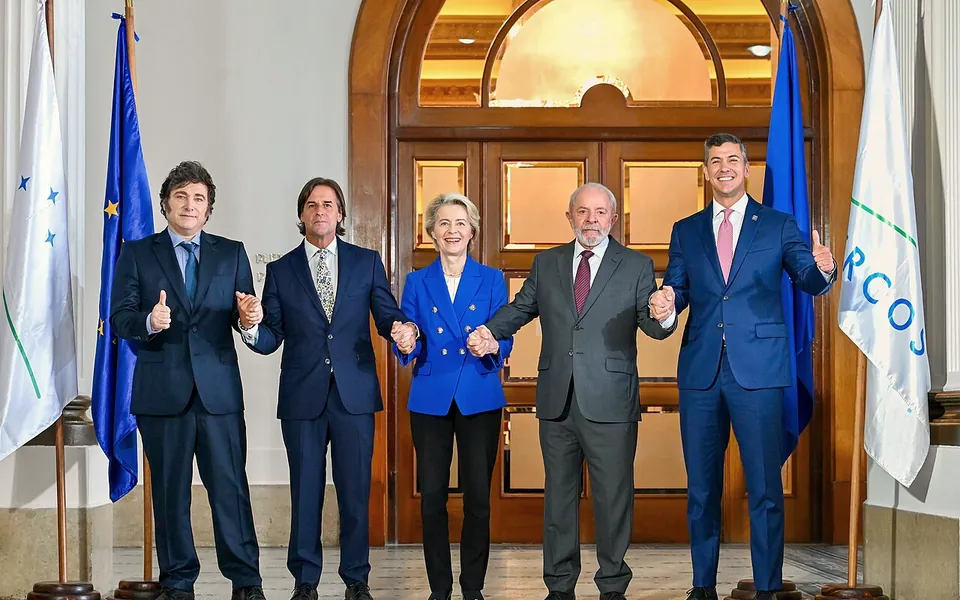
On 6 December 2024, in Montevideo, the president of the European Commission, Ursula von der Leyen, announced, together with the presidents of Argentina (Javier Milei), Brazil (Luiz Inácio Lula da Silva), Paraguay (Santiago Peña) and Uruguay (Luis Lacalle Pou), the conclusion of negotiations on the trade agreement between the European Union and Mercosur. It ends a negotiation that had lasted about 25 years. Von der Leyen called it an “ambitious and balanced” agreement and a “political necessity”. The Commission speaks of a free trade area of more than 700 million people and of savings for European companies of more than €4 billion a year in customs duties.
What the agreement covers
According to the Commission, the agreement removes tariffs that are today “often prohibitive” for European exports: up to 35% on cars, between 14% and 20% on machinery, up to 35% on wines and spirits, up to 31.5% on olive oil and 28% on cheese. It also sets rules on intellectual property, including geographical indications (more than 350 European food and drink products would be protected), food safety and competition.
In the other direction, the EU opens its market to South American products through quotas and timetables. The beef quota is 99,000 tonnes at a reduced tariff of 7.5%, which the Commission puts at around 1.5% of European production. Other quotas, such as those for poultry, rice or honey, would open gradually over five years, and the Commission points out that imports will have to meet European health standards.
What has changed since 2019
The EU and Mercosur had already reached a political agreement on 28 June 2019, which was never ratified: France, Ireland, Austria and the Netherlands ended up demanding additional environmental conditions. The text now concluded provides, according to the Commission, that the Paris Agreement is an “essential element” of the relationship, with concrete commitments to halt deforestation and enforceable commitments on labour and sustainable forest management. According to Eunews, either side could suspend the benefits in whole or in part if the other breaks its climate commitments. Bilateral safeguards are added to protect specific agricultural sectors, together with a mechanism to request a review of measures that substantially reduce the benefits of the pact.
What is missing and what it means for Spain
Concluding the negotiation is not yet entry into force. The Commission said that, after the final legal review by both sides, the text will be translated into all the EU’s official languages and submitted to the Council and the European Parliament. One decisive question remains open: whether it is processed as a mixed agreement, which requires unanimity in the Council and ratification by national parliaments, or as a trade-only agreement, which is approved by qualified majority. The Commission spokesman Olof Gill said it would decide “when the time comes”.
A trade-only agreement would need the votes of at least 15 of the 27 member states representing 65% of the population, plus a majority in the European Parliament. France, whose presidential palace called the text “unacceptable as it stands”, was trying to assemble a blocking minority. Poland repeated its opposition, Italy said the conditions for signing were not in place, and Austria and the Netherlands expressed reservations. Germany and Spain support it.
In Spain, the government defends the agreement. Pedro Sánchez celebrated it on X as “an unprecedented economic bridge between Europe and Latin America”, the economy minister, Carlos Cuerpo, presented it as a great victory for Spain and the EU, and the agriculture minister, Luis Planas, called it a major opportunity for the agri-food sector. The government highlights the benefits for wine and olive oil. The farming organisations Asaja, COAG and UPA, by contrast, reject it: they say it was drawn up in haste and without regard for the interests of European producers, and citrus growers fear that trade barriers will fall.
Anyone who exports to or imports from Argentina, Brazil, Paraguay or Uruguay can start by looking at what tariff each product pays today, how much it weighs in the final price and what reduction timetable would apply. Until the text is ratified nothing changes at customs, so it is better to prepare scenarios than to decide on a pact that can still be amended. Ask your adviser how it affects your business.
An agreement concluded at the table is an opportunity; only ratification turns it into law.
This article is general information. It is not legal, tax or investment advice, and it does not take anyone’s particular circumstances into account.