On 7 December 2024 Notre-Dame de Paris reopened its doors more than five years after the fire. What the restoration cost, who paid for it and what it shows about cultural patronage.
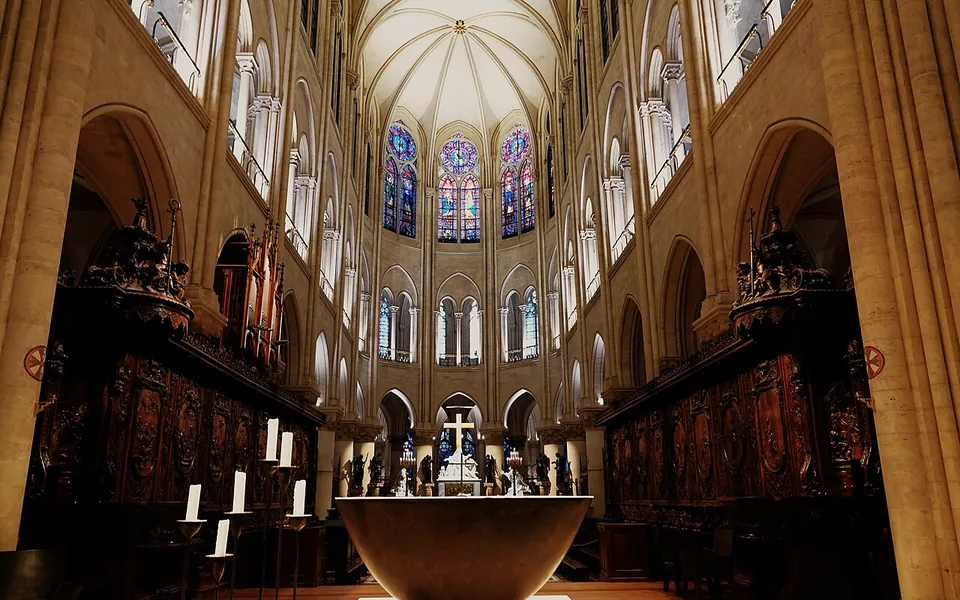
On the evening of Saturday 7 December 2024, Notre-Dame de Paris reopened its doors more than five years after the fire of 15 April 2019. The Archbishop of Paris, Laurent Ulrich, knocked three times on the closed doors with the base of his crosier, carved from beams burned in the fire, and the choir answered each time before they opened. The organ, silent for almost five years, sounded again, and the 13-tonne bell Emmanuel rang to mark the start.
About 1,500 guests attended, among them around 40 heads of state and government: the French president, Emmanuel Macron; the US president-elect, Donald Trump; the first lady, Jill Biden, representing President Joe Biden; Prince William; Ukraine’s president, Volodymyr Zelensky; and the leaders of Italy, Germany and Brazil, among others. Macron thanked “all those who saved, helped and rebuilt” the cathedral and highlighted the work of more than 2,000 people over five years. The first Mass, with the consecration of the high altar, was held on Sunday 8 December.
What it cost and who paid
The restoration cost about €700 million, according to Al Jazeera. Donations raised totalled €846 million, from some 340,000 donors in 150 countries, according to figures reported by the Adnkronos agency; around 98% of the pledges had been honoured or turned into binding commitments. Most of it came from France: about €60 million came from foreign donors, more than half of them American.
Among the large donors were the Arnault (LVMH), Bettencourt Meyers (L’Oréal) and Pinault families, and companies such as Total, Axa, Sanofi, Bouygues and Société Générale, according to information reported by Finestre sull’Arte; alongside them were thousands of contributions from private individuals. Almost 2,000 people and about 250 companies and laboratories took part in the work, and the cathedral was closed for 2,063 days, that is, five years, seven months and 22 days.
Cultural patronage
Notre-Dame is the most visible example of how much private funding can contribute to cultural heritage. In Spain, Act 49/2002, amended by Royal Decree-Law 6/2023, regulates the tax incentives for donations to the organisations covered by it. Since 1 January 2024, an individual deducts from their personal income tax liability 80% of the first €250 donated and 40% of the rest; the rate rises to 45% for recurrent donors to the same organisation.
For companies, the deduction is 40% of the full corporate income tax liability (50% for recurrent donors), with a limit of 15% of the taxable base; whatever exceeds that limit can be applied for up to ten consecutive years. These are the figures from the Tax Agency. The incentives depend on the type of organisation and of donation, and not all cultural bodies are covered by them.
After the reopening
After the reopening, the cathedral’s authorities expect between 14 and 15 million visitors, compared with 12 million in 2017. The French government had floated charging tourists an entrance fee, and the Catholic Church defended keeping access free, which remains the case for now.
Anyone thinking of becoming a patron can check three things before donating: that the organisation is covered by Act 49/2002, the amount and the recurrence, which set the deduction rate, and the maximum that can be deducted each year. Ask your adviser how this applies to your case.
Notre-Dame reopened thanks to thousands of donors; with good tax rules, patronage can sustain what nobody wants to lose.
This article is general information. It is not legal, tax or investment advice, and it does not take anyone’s particular circumstances into account.