President Yoon Suk-yeol declared martial law on the night of 3 December 2024, and the National Assembly demanded it be lifted in the early hours. What happened and how the won and the stock market reacted.
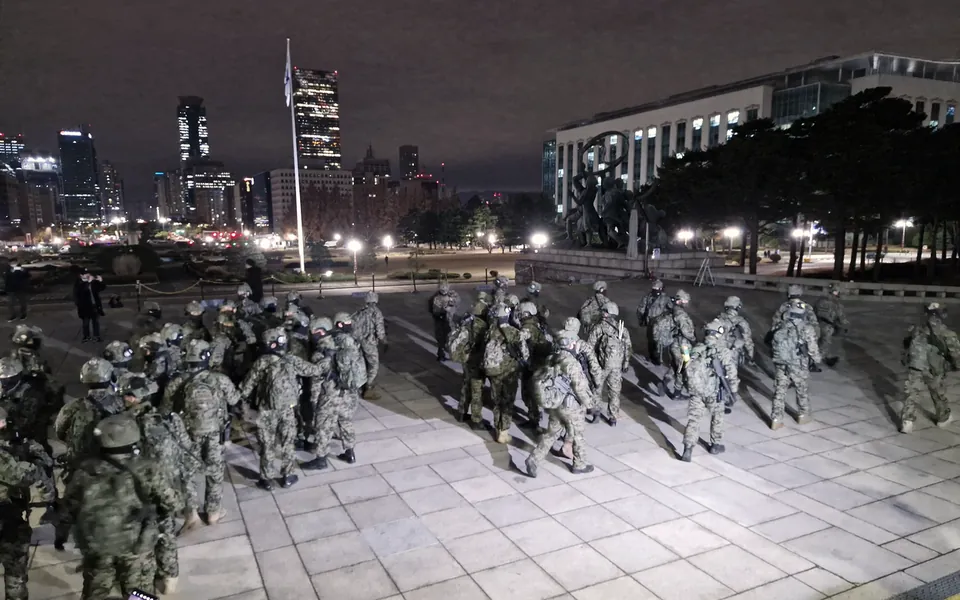
On the night of Tuesday 3 December 2024, South Korea’s president, Yoon Suk-yeol, unexpectedly announced martial law. He justified it by accusing the main opposition party, the Democratic Party, of acting as an “anti-state force”. According to the military, the activities of parliament and other political gatherings that could cause “social confusion” were suspended, and anyone who broke the order could be arrested without a warrant.
The response came within hours. With 190 of its 300 members present, the National Assembly voted unanimously, in the early hours, for a resolution demanding that the measure be lifted. The constitution requires the president to comply when the Assembly asks for it by a majority. Yoon said he would withdraw it and, at about 4:30 on Wednesday 4 December, local time, his government formally lifted it at a cabinet meeting. Martial law had been in force for about six hours. It was the first to be declared in the country since its democratisation in 1987.
How the markets reacted
The first thermometer was the currency. On Tuesday night the won fell to 1,444.93 to the dollar, its weakest level since 2022, according to LSEG data reported by CNBC. After the vote in parliament it recovered most of that loss, and on Wednesday it was trading at around 1,414 to the dollar.
Because the measure was declared and withdrawn while the Seoul market was closed, the first adjustment was seen outside Korea. The iShares MSCI South Korea exchange-traded fund fell by as much as 7% in New York during Tuesday’s session, to 52-week lows, and closed down 1.6%. The Korea Exchange confirmed that trading on Wednesday would start as normal at 9:00.
The stock market opened lower. The Kospi index lost more than 2% at one point during Wednesday’s session and closed down 1.44%, at 2,464.00 points. The Kosdaq, which groups smaller companies, fell 1.98%. Foreign investors were net sellers of about 409 billion won. Among the large companies, Samsung fell by around 1%, LG Energy Solution by 2.8% and Hyundai Motor by 2.4%.
The yield on the three-year government bond rose by 3.8 basis points, to 2.625%. The authorities tried to calm nerves: the Ministry of Economy and Finance said it would provide “unlimited liquidity” if necessary, and Vice-Minister Kim Byung-hwan said regulators were ready to deploy 10 trillion won, about $7.06 billion, to stabilise the stock market “at any time”.
What remains open
The political crisis is not over. On Wednesday the opposition began proceedings to impeach Yoon, and the outcome remains open. The analysts cited by CNBC agreed that uncertainty continued. Natixis said the reversal is positive but adds political uncertainty; Deutsche Bank described the situation as calmer for now, though it asked for it to be monitored because of South Korea’s role in global supply chains; and TS Lombard expected volatility to continue in Korean and Asian markets, especially in currencies.
For a business or a family here, the direct effect usually comes through two channels: any Korean assets held in portfolios or funds, and suppliers of components such as semiconductors or batteries. It is worth knowing how much exposure there is to each, and checking whether any supply contract depends on a single factory or a single country, without letting an episode lasting a few hours force hasty decisions.
Ask your adviser how this applies to your case.
Political risk can appear and withdraw in a single night, but markets reflect it within hours.
This article is general information. It is not legal, tax or investment advice, and it does not take anyone’s particular circumstances into account.