On 12 June 2018 a sitting US president and a North Korean leader met for the first time and signed a short text with no deadlines or verification. What it says, what Trump announced on military exercises and how markets reacted.
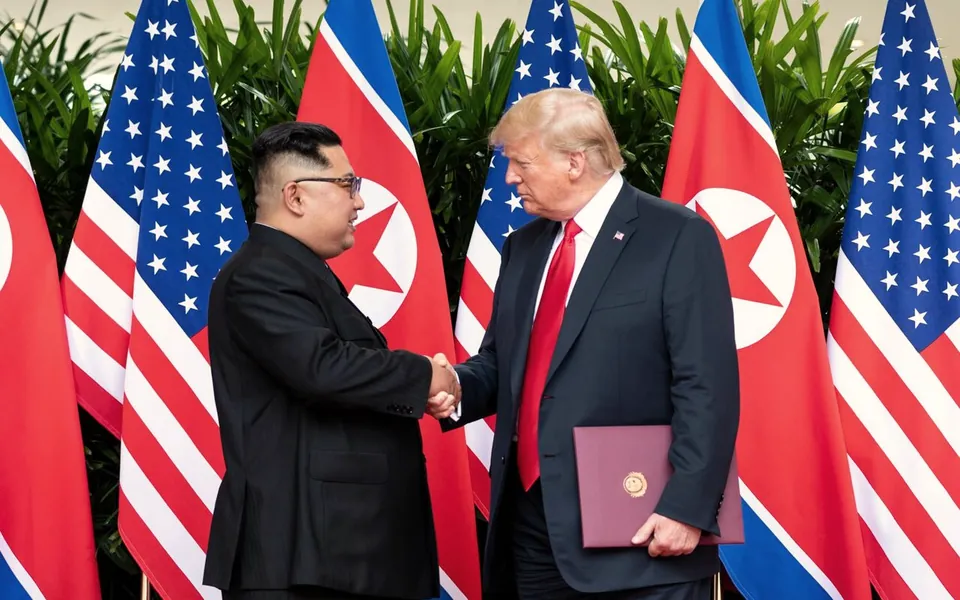
On Tuesday 12 June 2018, US President Donald Trump and Kim Jong-un, Chairman of North Korea’s State Affairs Commission, met at the Capella Hotel on Sentosa Island in Singapore. According to the White House, it was the first summit between a sitting US president and a North Korean leader. After a one-on-one meeting, another with their delegations and a working lunch, the two signed a joint statement.
What the declaration says
The text contains four commitments. First, the two countries commit to establishing new relations, in line with the wish of their peoples for peace and prosperity. Second, they will join efforts to build a lasting and stable peace regime on the Korean Peninsula. Third, North Korea commits to working towards the complete denuclearisation of the peninsula, reaffirming the Panmunjom Declaration of 27 April 2018. Fourth, both commit to recovering the remains of prisoners of war and those missing in action, including the immediate repatriation of those already identified.
The document adds that Trump commits to providing security guarantees to North Korea and that Kim reaffirms his commitment to denuclearisation. The two sides agree to open follow-up negotiations, led by Secretary of State Mike Pompeo and a senior North Korean official, at the earliest possible date.
What the text does not say also matters: there is no timetable, no definition of what denuclearisation covers and no verification mechanism. Asked about this at the press conference, Trump replied that there will be verification, with US personnel and staff from international organisations, and that it had not been put in the document because there had been no time. He added that Kim had told him North Korea was already destroying a major missile engine testing site, which is not in the signed text either.
Sanctions and military exercises
In the same appearance, Trump said sanctions will remain in force and that he will lift them when he is sure nuclear weapons are no longer a factor. He also announced that the United States will stop what he called “war games”, meaning the joint exercises with South Korea, as long as negotiations go well: he said this will save a great deal of money and that he finds them provocative. Withdrawing US troops from South Korea, he added, is not part of the equation for now.
The announcement surprised allies. According to US press reports on 13 June, the office of South Korean President Moon Jae-in said it needed to work out the exact meaning of Trump’s words, and US Forces Korea said it had received no guidance and would keep its current posture until it did. The annual Ulchi Freedom Guardian exercise was planned for this summer; last year it involved about 50,000 South Korean and 17,500 US troops.
How markets reacted
Markets reacted calmly. According to Reuters, on the day of the summit Japan’s Nikkei finished up 0.6% and South Korean shares were up 0.2%; gold was down 0.2%, at about $1,298 an ounce, and Brent held at around $76 a barrel. An ING analyst, Robert Carnell, described the economic effect that ending the stand-off and sanctions would have on trade and corporate earnings as marginal. The next day Reuters summed up the session by saying stocks and the dollar were steady, with attention on that week’s Federal Reserve meeting.
For companies, the sanctions framework is unchanged: no formal decision has altered it, and any change will depend on what is agreed in the follow-up negotiations. Those talks, which the declaration says should be held at the earliest possible date, are what is worth watching.
The summit opens a channel for dialogue, but the text sets goals rather than deadlines: what matters will be decided in the negotiations to come.
This article is general information. It is not legal, tax or investment advice, and it does not take anyone’s particular circumstances into account.