The right-wing coalition led by Giorgia Meloni won Italy’s election on 25 September 2022, according to provisional results published on the 26th. What is known and how the markets reacted.
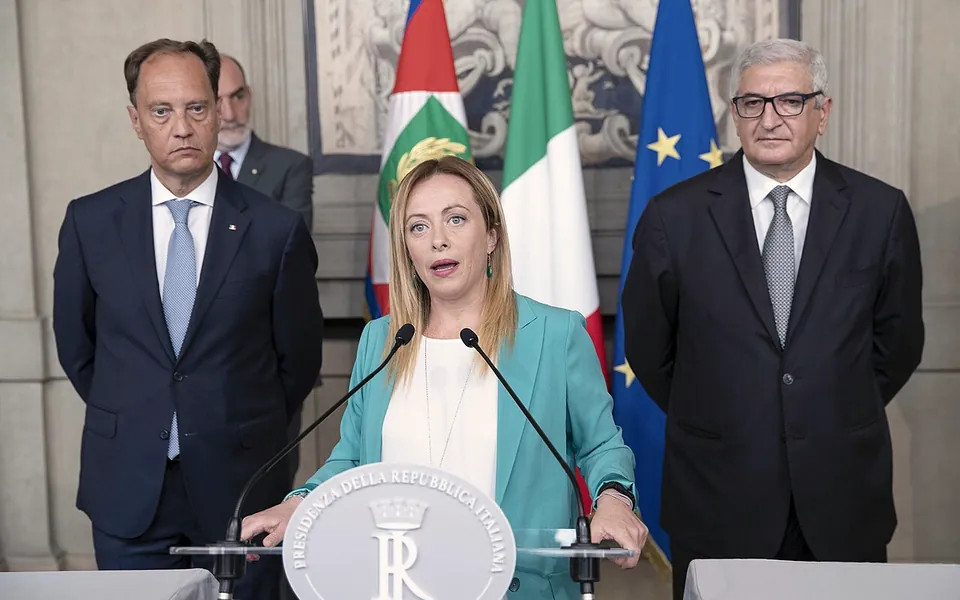
Italy voted on Sunday 25 September 2022 in an early election, called after the fall of Mario Draghi’s government in July. The provisional results known on Monday 26 give victory to the right-wing coalition (the centrodestra) made up of Brothers of Italy (Fratelli d’Italia), led by Giorgia Meloni; the League, led by Matteo Salvini; and Forza Italia, led by Silvio Berlusconi.
What the results say
In the provisional count, Brothers of Italy rose from around 4% in 2018 to just over 26% and is the country’s largest party. The Democratic Party came in at around 19%, the Five Star Movement at about 15%, the League at around 9% (against more than 17% in 2018) and Forza Italia at about 8%. These are provisional figures and may change in the final count.
The centre-right took about 44% of the vote and, thanks to an electoral system that combines proportional lists and single-member constituencies, projections give it an absolute majority of seats in the Chamber of Deputies and the Senate. Turnout was around 64%, a record low for a general election. The final allocation of seats and the names of the next government are not yet known.
What happens next
The new chambers will meet for the first time on 13 October to elect their presidents. After that, the President of the Republic, Sergio Mattarella, consults the parties and appoints the Prime Minister, who must win the confidence of both chambers. Meloni, leader of the coalition’s most-voted party, is the favourite to lead the government and would be the first woman to do so. In her first remarks after the result, she promised to govern for all Italians.
The three coalition parties will have to agree on the government and on its response to energy prices, the most urgent issue it will face.
The market reaction
Before the vote the risk premium had barely moved: according to Bloomberg Línea, it had risen about 15 basis points since 19 July, the eve of Draghi’s resignation, and Meloni’s messages about respecting the EU’s budget rules and the roughly €200,000 million of European recovery funds had helped to contain it. The investment bank JPMorgan warned, however, that a very large majority for the coalition could be a negative surprise for markets.
On Monday 26, according to Reuters, the spread between Italian and German 10-year bonds reached 238 basis points, a two-week high, and then moved around 236. The FTSE MIB index rose as much as 1.3% in early trading before cutting its gains, and closed up about 0.7%, according to Money.it. Several analysts quoted by Reuters agreed that the result was expected and that markets were not reacting to politics. They pointed to the formation of the government, the appointment of the economy minister and the dialogue with Brussels over the recovery plan as the points to watch.
The backdrop is a European Central Bank that has had, since July, the Transmission Protection Instrument (TPI) to act against unwarranted and disorderly market movements. The ECB has explained that its activation depends on several conditions, among them that the country complies with the EU’s fiscal rules and the commitments of its recovery plan and that its public debt is sustainable.
Italy has a clear result; the government, the budget and the relationship with Brussels are what remain to be defined.
This article is general information. It is not legal, tax or investment advice, and it does not take anyone’s particular circumstances into account.