Claudia Sheinbaum won the 2 June 2024 election and will be Mexico’s first woman president. The peso fell more than 4% in one session. What it means for Spanish companies doing business there.
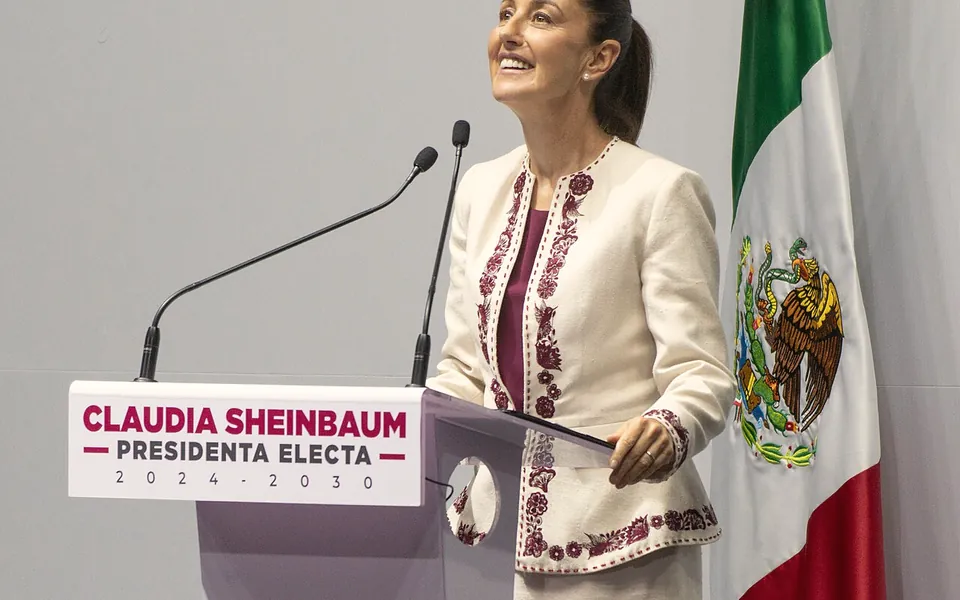
Mexico held general elections on Sunday 2 June 2024. According to the quick count by the National Electoral Institute (INE), Claudia Sheinbaum, a former head of government of Mexico City and the candidate of the coalition of the current president, Andrés Manuel López Obrador, won between 58.3% and 60.7% of the vote, a lead of about 30 points over her main rival, Xóchitl Gálvez. Jorge Álvarez Máynez, of Movimiento Ciudadano, came third with about 10% of the vote. She will be the first woman president in the country’s history and takes office on 1 October. The official district-by-district count is still under way, so the figures are provisional.
The peso’s reaction
Markets responded on Monday 3 June. The peso fell more than 4% against the dollar and closed at around 17.7 pesos to the dollar, from about 17.0 the previous Friday, in what the Mexican press described as its worst session since the 2020 pandemic. The Mexican stock market also fell sharply.
Analysts attributed it to the fact that, according to preliminary projections, the governing coalition could reach a two-thirds majority in both houses of Congress, something that had not been expected on that scale. With that majority it could amend the Constitution without negotiating with the opposition, and the outgoing president’s proposals included changes to pensions and to the election of judges. Investors also pointed to the central bank’s autonomy, fiscal discipline and the possible disappearance of autonomous bodies as risks. These are analysts’ fears, not measures that have been adopted: Sheinbaum does not take office until 1 October.
Spanish companies’ exposure
Mexico is one of the most important markets for Spanish business. According to Mexican Economy Ministry data reported by the press in 2023, Spain is the second-largest foreign investor in the country, behind only the United States, with $57,375 million accumulated between 2006 and the first half of 2023. Spanish investment reached $4,224 million in the first half of 2023, against $2,075 million a year earlier, and spans sectors such as banking, automotive, telecommunications, hotels and restaurants, and agribusiness.
The most visible case is banking. BBVA earned €5,340 million in Mexico in 2023, the largest of its markets, against group attributable profit of €8,019 million, so the trend of the peso and the Mexican economy weighs directly on its accounts in euros. Other Spanish multinationals, such as Santander and Repsol, also do business in the country.
What to review
When the peso weakens, the profits a Mexican subsidiary earns in pesos are worth less when converted into euros, and dollar debts become more expensive to pay for anyone whose income is in pesos. When it strengthens, the opposite happens. That is why companies with business in Mexico usually review what share of their revenue and costs is in pesos, whether they have currency hedges and how far they depend on sectors sensitive to government decisions, such as energy, banking or concessions.
For a business owner who exports to Mexico or has a local partner or subsidiary there, or for a family whose investments include Mexican assets, the practical question is not to guess the peso’s next move but to know how much exposure they have and over what time horizon. It is also worth following the calendar: the INE’s official count is still under way, the final make-up of Congress will be known later and the new president does not take office until October. Ask your adviser how it applies to your case.
Mexico’s political map has changed; what changes in its economic rules has not yet been decided.
This article is general information. It is not legal, tax or investment advice, and it does not take anyone’s particular circumstances into account.