On 22 February 2024 a fire gutted a 138-flat building in the Campanar district of Valencia, killing ten people. What is known and what to review in insurance and in the facade.
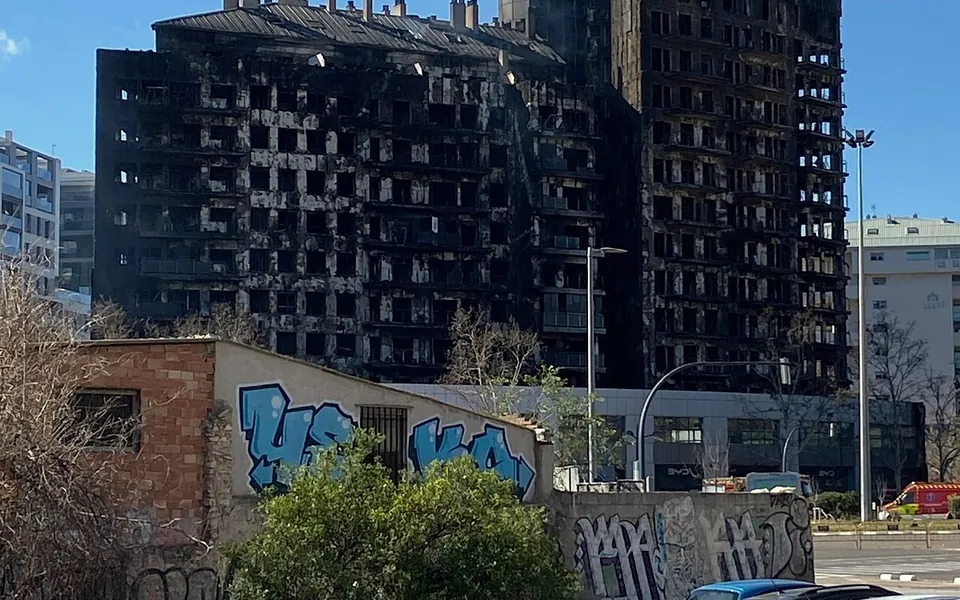
On the evening of Thursday 22 February 2024 a fire broke out in a 14-storey residential building with 138 flats in the Campanar district of Valencia. The fire spread rapidly across the facade, in gusts of wind of up to 60 kilometres an hour, and left the building gutted. The building, completed around 2008, had 139 co-owners.
What is known
According to the authorities, ten people died: nine bodies were recovered on Friday 23rd and the tenth on Saturday 24th. Fifteen people were injured, seven of them firefighters, none in danger of death. About a hundred survivors spent Friday night in hotels. The city council declared official mourning until noon on Monday 26 February.
The cause of the fire had not been established and the forensic police were investigating under judicial secrecy. A fire service official, Faustino Yanguas, said the facade cladding had to be investigated and that it was a factor that contributed greatly to the rapid spread of the fire.
The debate over the facade
The president of Valencia’s COAT, Luis Sendra, explained that early observations suggested the ventilated facade, common at the time, probably explained the speed of the fire together with the wind. It is an air cavity with outer aluminium panels up which flames can rise, in a “chimney effect”. He could not yet say what insulation it contained.
Several architects consulted by the press pointed out that the building predates current requirements. Fire barriers in the facade cavity, which would slow vertical spread, were not mandatory when the work was put out to tender in 2005, and since 2011 the rules require facade products to meet certain fire-performance standards. Existing buildings are not obliged to adapt unless an inspection detects a risk or the facade is replaced. Rafael Royo, of the Universitat Politècnica de València, recommended that owners’ associations commission an expert survey to check that the material on their facade does not spread fire and to decide, where appropriate, whether to replace or cover it.
Insurance and what to review
The building had a policy taken out by the owners’ community insuring the property for €26.5 million. It covered fire and, through the Consorcio de Compensación de Seguros, extraordinary risks, and included third-party liability of €782,996. According to the consumer organisation OCU, the community’s policy usually covers the common areas and sometimes the private parts as well; each owner’s home insurance normally covers their private part and the contents, that is, furniture, electronics and valuables. The policy had been in force since 1 February 2024. The sum insured is the maximum limit of compensation, not an amount paid out automatically: the final amount depends on the assessment of the damage.
Each owner can ask the administrator for the community’s policy and check what it covers: whether it includes the private parts, at what reconstruction value the building is insured and what third-party liability limit it has. It is also worth reviewing your own home insurance: the sum insured for contents, whether there is an inventory with photographs and invoices, and whether it covers temporary accommodation if the home becomes uninhabitable.
The community, for its part, needs to know what facade system the building has, what documentation backs it up and whether it should commission an expert survey. Ask your property administrator and your insurance broker how this applies to you.
Well-sized insurance does not prevent a fire, but it decides what can be rebuilt afterwards.
This article is general information. It is not legal, tax or investment advice, and it does not take anyone’s particular circumstances into account.