On 31 October 2023, on turning 18, the Princess of Asturias swore to uphold the Constitution before the Cortes Generales. What Article 61 requires and what the Constitution says about succession to the Crown.
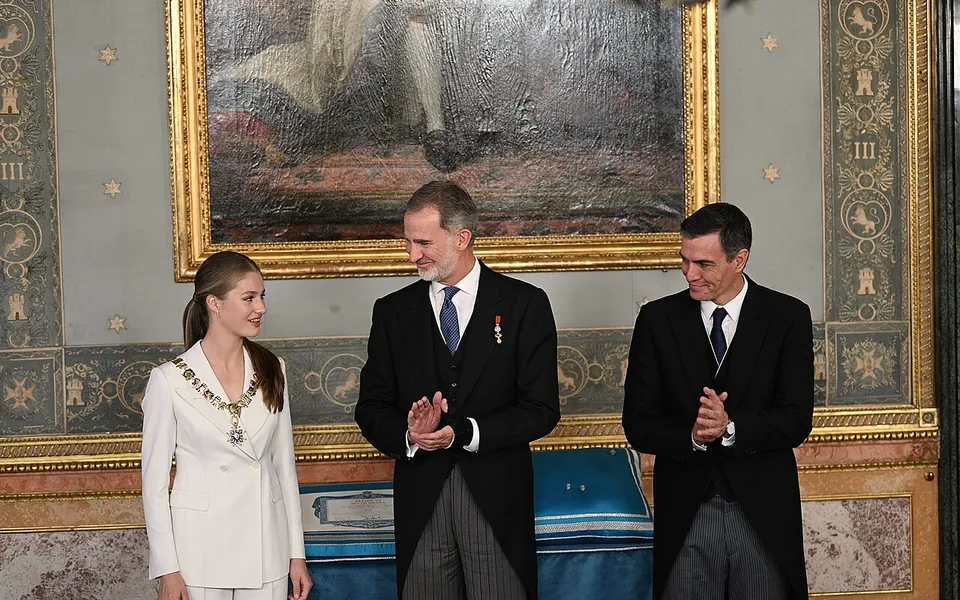
On Tuesday 31 October 2023, her 18th birthday, the Princess of Asturias, Leonor de Borbón, swore to uphold the Constitution before the Cortes Generales, meeting in joint session in the Congress of Deputies. The King and Queen, the Infanta Sofía and the acting prime minister, Pedro Sánchez, attended, along with representatives of the state’s institutions.
What happened in Congress
The Council of Ministers had requested the joint session at its meeting on 10 October. The Speaker of the Congress, Francina Armengol, opened and chaired the ceremony; the chief clerk of the Cortes read the Government’s decision, and the princess swore on the same copy of the Constitution used by her father, Felipe VI, on 30 January 1986, when he also turned 18. After the oath, the presidents of the Congress and the Senate presented her with the medals of both chambers, and she signed the Congress’s Book of Honour.
The wording of the oath is the one laid down by the Constitution: to carry out her duties faithfully, to keep and enforce the Constitution and the laws, to respect the rights of citizens and of the autonomous communities and, in addition, loyalty to the King. According to press reports, the ceremony ended with several minutes of applause in the chamber. The same day the princess also received the Collar of the Order of Charles III, at a ceremony attended by the acting prime minister.
What the Constitution says
Article 61 of the Constitution provides for two oaths. The King swears his on being proclaimed before the Cortes Generales: to carry out his duties faithfully, to keep and enforce the Constitution and the laws, and to respect the rights of citizens and of the autonomous communities. Paragraph 2 adds that the crown prince, on coming of age, and the regent or regents on taking up their functions, swear the same oath, together with one of loyalty to the King. Coming of age is reached at 18 (Article 12).
Article 57 states that the Crown of Spain is hereditary in the successors of Juan Carlos I and that succession follows the regular order of primogeniture and representation: the earlier line is preferred to later ones, the nearer degree to the more remote and, within the same degree, the male to the female and the older person to the younger. The heir holds the dignity of Prince of Asturias from birth or from the event that gives rise to the succession. Leonor, the King’s elder daughter, is first in line and has no brother in the same degree.
Abdications, renunciations and any doubt of fact or law arising in the order of succession are to be resolved by an organic law (Article 57.5). And if all the lines called by law were extinguished, the Cortes Generales would provide for the succession “in the manner most suited to the interests of Spain” (Article 57.3).
What coming of age changes
Coming of age also has a practical effect: under Article 59.2, if the King were incapacitated for the exercise of his authority and the Cortes Generales recognised that incapacity, the crown prince would immediately take over as regent, provided he or she were of age. To act as regent a person must be Spanish and of age (Article 59.4).
The oath does not alter the order of succession, which the Constitution already sets; it confirms the heir’s formal commitment to it on coming of age.
This article is general information. It is not legal, tax or investment advice, and it does not take anyone’s particular circumstances into account.