Spain won their first Women’s World Cup in Sydney on 20 August 2023, beating England 1-0. The final was the most-watched women’s football match in Spanish history, and the tournament broke attendance records.
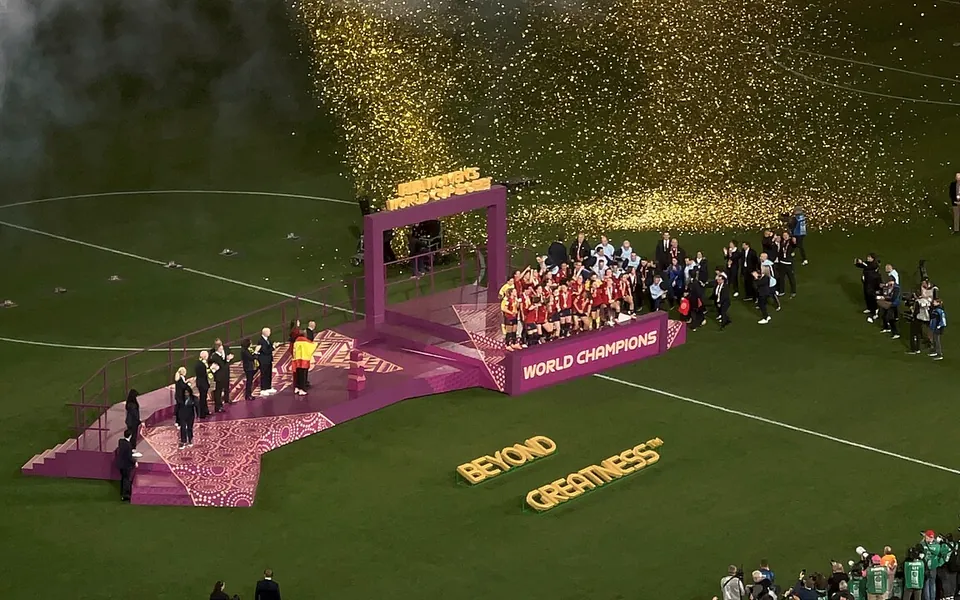
Spain’s women’s football team became world champions on Sunday 20 August 2023 at Stadium Australia in Sydney. They beat England 1-0 with a goal from left-back Olga Carmona in the 29th minute and became the fifth different nation to win the tournament, after the United States, Germany, Norway and Japan. It is their first world title, in the first Women’s World Cup played with 32 teams.
An unprecedented audience
According to figures released by the Royal Spanish Football Federation, the final was watched on TVE’s La 1 by an average of 5,599,000 viewers, with a 65.7% audience share. The peak came at 14:02, in the closing moments of the match, with 7,382,000 viewers and a 71.1% share. In all, 8,858,000 different people tuned in at some point. It is the most-watched women’s football match in Spanish history.
Before kick-off, the average audience had been 1,596,000 viewers (a 34.2% share), so interest grew as the match went on. A 65.7% share means that around two in every three television sets switched on during the final were tuned to it. The post-match broadcast, with the players’ celebrations, averaged 6,226,000 viewers. These are the figures released the day after the final.
The business of the tournament
The World Cup, co-hosted by Australia and New Zealand from 20 July to 20 August, ended with a cumulative attendance of 1,978,274 across its 64 matches, a record for the tournament. FIFA reports more than 1.8 million tickets sold, against an initial target of 1.3 million, later raised to 1.5 million. The final had 6,890 corporate hospitality guests, the highest figure for a Women’s World Cup match.
On the commercial side, FIFA sold for the first time a dedicated sponsorship programme for the Women’s World Cup, separate from the men’s, and went from 12 commercial partners in 2019 to 30 in 2023. The competition was shown in around 200 territories through 130 broadcasters, according to the governing body.
Prize money also changed scale. FIFA allocated $110 million to the participating federations, against $30 million in 2019 and $15 million in 2015, within a total package of $152 million that includes preparation funding and a club benefits programme. It also set a payment model that guarantees an amount to every player depending on the stage reached: $30,000 for playing the group stage and $270,000 for winning the title; the runners-up earned $195,000 per player and the third-placed team $180,000. The men’s 2022 World Cup in Qatar distributed $440 million.
What it leaves for the sport
For brands and broadcasters, the final is an argument for treating women’s football as a product in its own right: a Sunday-morning match took more than 65% of the audience on public television. For federations and clubs, the challenge is to sustain that interest outside the big tournaments, in domestic competitions, and to narrow an income gap with men’s football that the World Cup prize money itself makes plain.
A sporting title is also measured in audiences, sponsorship and prize money, and this final has raised all three.
This article is general information. It is not legal, tax or investment advice, and it does not take anyone’s particular circumstances into account.