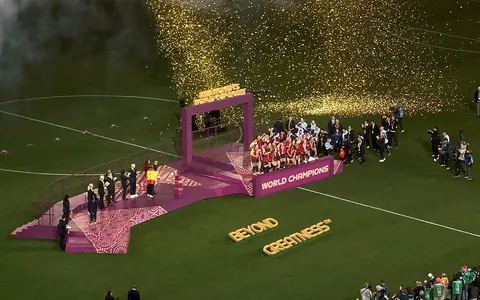
Argentina beat France on penalties on 18 December 2022 to win the Qatar World Cup final (3-3 and 4-2). A look at the tournament in numbers: attendance, prize money and FIFA’s revenue.
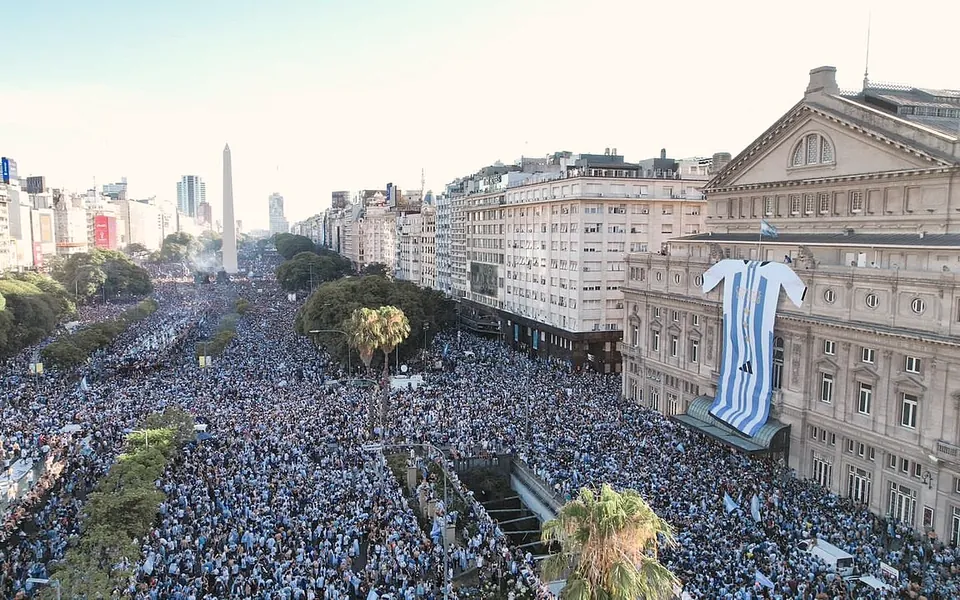
The Qatar World Cup final was played on Sunday 18 December 2022 at Lusail Stadium, which holds about 89,000 people. Argentina went 2-0 up with goals from Lionel Messi, from the penalty spot, and Ángel Di María; Kylian Mbappé equalised with two goals in under two minutes, Messi put his side ahead again in extra time and Mbappé levelled once more, from the spot, to complete a hat-trick, the first in a final since Geoff Hurst’s in 1966.
Argentina won 4-2 in the penalty shoot-out. It is their third World Cup title, after 1978 and 1986, and Messi’s first; he was named the tournament’s best player, while Mbappé was top scorer with eight goals. Messi also played his 26th World Cup match, more than any other player.
The tournament in numbers
Sixty-four matches were played in eight stadiums in Qatar between 20 November and 18 December, with 32 teams and 172 goals, a record for a World Cup in this format, according to FIFA. The stadiums drew about 3.4 million spectators, an average of more than 53,000 per match. On 16 December, with two matches still to play, FIFA put the figure at 3.27 million. Three Asian teams reached the knockout stage and Morocco became the first African team to reach a semi-final.
FIFA had not published global audience figures for Qatar 2022 by 19 December. As a reference, its audit of Russia 2018 counted 3,572 million viewers, 51.3% of the world’s population aged four and over, and 1,120 million for the final.
What FIFA earns
On 20 November, the opening day, FIFA told its member associations that the 2019-2022 cycle would bring in about $7.5 billion of revenue, against $6.4 billion in the previous cycle, thanks to commercial deals with new sponsors such as QatarEnergy, according to AP. For the next cycle it expected income close to $10 billion, helped by women’s football contracts and an enlarged 2026 World Cup, and, according to the same agency, it had used money from the previous cycle to help its associations when national-team football stopped in 2020.
On 16 December its president, Gianni Infantino, said the tournament had generated more than $1 billion above forecast and estimated income of more than $11 billion for the cycle ending with the 2026 World Cup. Infantino called the tournament the best World Cup in history.
The prize money
The prize money was the largest in World Cup history: $440 million. Argentina collects $42 million and France $30 million; the third-placed team receives $27 million and the fourth $25 million; teams knocked out in the group stage get $9 million each. All teams also received $1.5 million before the tournament for preparation costs.
The tournament was played for the first time in November and December. The next World Cup, in 2026, will be held in the US, Canada and Mexico, with 48 teams instead of 32, and FIFA was then studying a format of 16 groups of three.
For businesses, the value of a World Cup as a shop window is measured in audiences, and the revenue figures are those announced by FIFA, which may change when it publishes its accounts.
A World Cup is no longer just football: it is a multi-billion business measured in audiences and contracts.
This article is general information. It is not legal, tax or investment advice, and it does not take anyone’s particular circumstances into account.