On 13 December 2022 the US Department of Energy announced that an experiment on 5 December produced 3.15 MJ of fusion energy from 2.05 MJ of laser energy. What it means and why commercial power is still far off.
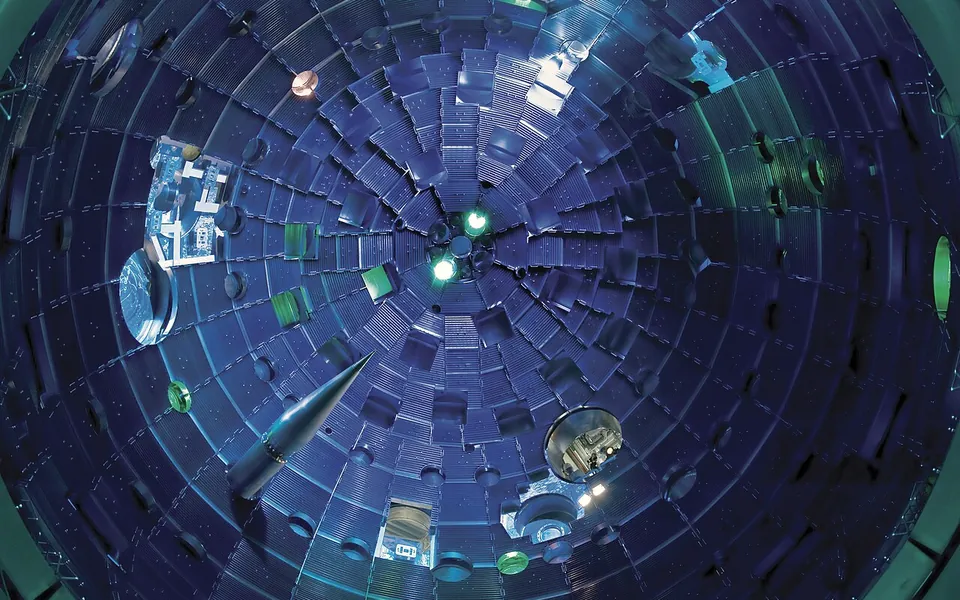
On 13 December 2022, US Energy Secretary Jennifer Granholm and the director of Lawrence Livermore National Laboratory (LLNL), Kim Budil, among other officials, announced in Washington that the laboratory, in California, had achieved nuclear fusion ignition. The experiment took place on 5 December at the National Ignition Facility (NIF), where 192 lasers send energy to a fuel capsule: they delivered 2.05 megajoules (MJ) and the reaction released 3.15 MJ. It is the first time that a fusion reaction in a laboratory has produced more energy than the laser that triggered it, which the Department of Energy (DOE) calls scientific energy breakeven. Also taking part were President Joe Biden’s chief science adviser, Arati Prabhakar, and the administrator of the National Nuclear Security Administration (NNSA), Jill Hruby.
What has been achieved
Nuclear fusion joins light nuclei, such as those of two isotopes of hydrogen, and releases energy; it is the process that powers the Sun. At the NIF, the lasers compress and heat a small fuel capsule until the reaction starts. The idea was born at the laboratory itself in the 1960s and, according to the DOE, represents more than 60 years of research. There are other approaches to achieving fusion, such as the magnetic confinement used in tokamak reactors, which pursue the same goal with different technology. On the official figures, the gain in this experiment is about 1.5 times (3.15 divided by 2.05), our own calculation.
What it does not mean
The comparison is made with the energy reaching the fuel, not with the electricity the facility consumes. According to NBC News, the lasers needed about 300 MJ of energy to fire about 2 MJ into the experiment, far more than was obtained. In addition, the NIF fires only a few times a day, against the ten per second that a power plant would need, according to an expert cited by NBC, and it was built to maintain the US nuclear arsenal, not to generate electricity.
The officials themselves qualify it. The DOE says that many scientific and technological advances are still needed before inertial fusion can supply simple, affordable energy to homes and businesses, and announced that it is restarting a coordinated inertial fusion energy programme, with the momentum of private investment. NBC adds that the engineering challenges (making capsules reliably, improving the efficiency of the lasers and converting the energy into electricity) could take years or decades; the estimates quoted range from the 10 to 15 years suggested by former Under Secretary of Energy Paul Dabbar to several decades.
What changes for businesses and families
In the short term, nothing: the news does not alter energy prices or energy investment decisions, and there is no reliable timetable for a commercial fusion power plant. It is a signal about where research is heading and about public funding: Senator Charles Schumer cited an authorisation of more than $624 million for this programme in this year’s defence act, according to the DOE.
Anyone interested in fusion companies should know that they are early-stage projects with uncertain results. This note is for information only and is not investment advice. Consult your adviser on how it applies to your case.
Ignition is a scientific milestone; commercial energy is another matter, and it is still a long way off.
This article is general information. It is not legal, tax or investment advice, and it does not take anyone’s particular circumstances into account.