On 29 January 2019 PG&E filed for Chapter 11 over its liabilities from the 2017 and 2018 wildfires. What the case shows about climate risk, insurance and the liability of utilities.
On 29 January 2019, PG&E Corporation and its subsidiary Pacific Gas and Electric, which supply electricity and gas to some 16 million people in northern and central California, voluntarily filed for Chapter 11 of the US bankruptcy code in the US Bankruptcy Court for the Northern District of California. The procedure lets a company keep operating while it restructures its debts and obligations under court supervision. The decision had been known since 14 January: that day chief executive Geisha Williams left her post, general counsel John Simon took over as interim chief executive and the shares fell by more than half at one point, according to Reuters.
What is known
The company asked the court for approval to draw $5.5 billion of debtor-in-possession financing, arranged by, among others, J.P. Morgan, Bank of America, Barclays and Citi. It says the money will maintain service and investment in safety and reliability while the process lasts. It also said it would pay suppliers in full and on normal terms for goods and services supplied from 29 January, and keep paying wages and benefits to its 24,000 employees. According to a court document cited by CNBC, it listed assets of $71.39 billion and liabilities of $51.69 billion.
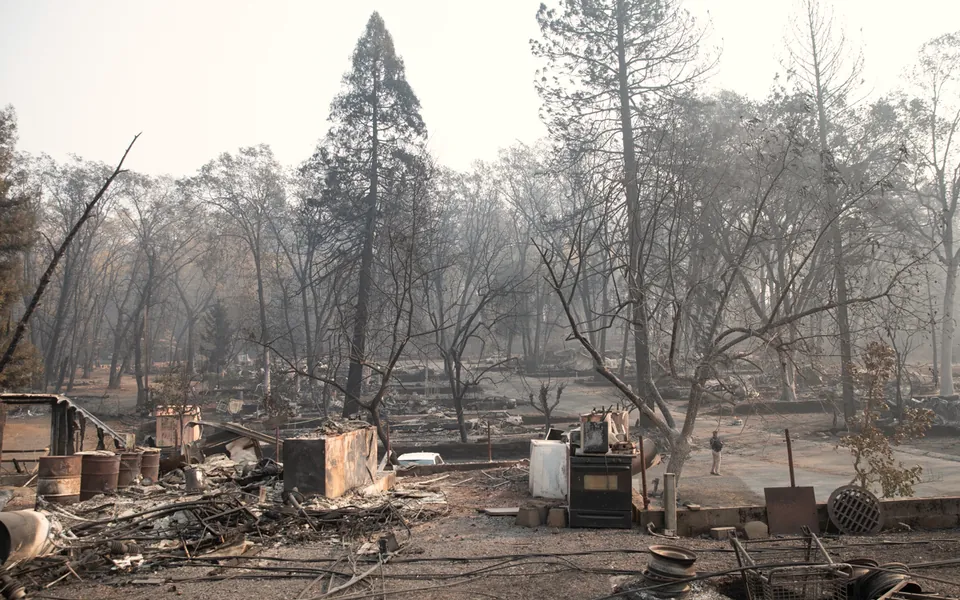
The origin is the 2017 and 2018 wildfires. The worst, the Camp Fire of November 2018, destroyed the town of Paradise and killed more than eighty people; it is the deadliest and most destructive in California’s history. Its cause was still under investigation. PG&E had warned in November that it could face significant liability above its insurance if its equipment was found to have started it, and on 14 January it put the potential total for the fires of both years at up to $30 billion. By contrast, on 24 January Cal Fire, the state fire agency, concluded that PG&E’s equipment did not cause the 2017 Tubbs fire.
Why a utility can go bankrupt because of wildfires
The key is the Californian doctrine of “inverse condemnation”: a utility can be held liable for the damage of a fire started by its equipment even if it was not negligent. PG&E cited that risk to question whether it could keep operating as a private company. A California law lets it pass part of the bill for the 2017 fires on to its customers, but not for 2018, Reuters noted, and elected officials showed little appetite for new rate rises, according to CNBC.
There is also an insurance and climate dimension. Munich Re calculated that the Camp Fire was the world’s costliest natural disaster of 2018, with total losses of $16.5 billion. If wildfires become more frequent and costly, the question of who pays (shareholders, customers, insurers or taxpayers) stops being theoretical, and the split is decided by the law, regulators and the courts.
The company’s advisers expected, according to Reuters, that the process could take up to two years. PG&E had already filed for Chapter 11 in 2001. Essential questions remain open: the cause of the Camp Fire, the size of the claims and the order in which they will be paid.
What to review
A company with contracts with a utility, or with any supplier in bankruptcy, needs to know where it stands as a creditor, what termination or continuity-of-supply clauses the contract contains and how much of its turnover depends on a single customer or supplier. Reuters named several energy companies, such as Kinder Morgan, among those most exposed to a PG&E bankruptcy.
Anyone with assets or activity in areas at risk of wildfire should review what each policy covers (property damage, business interruption, third-party liability), with what limits and exclusions, and not assume that current terms will last. Ask your adviser how this applies to your situation.
The PG&E bankruptcy shows that climate risk is already measured in balance sheets, policies and courtrooms.
This article is general information. It is not legal, tax or investment advice, and it does not take anyone’s particular circumstances into account.