From 1 July 2021 the EU Digital COVID Certificate applies across the EU, showing vaccination, a negative test or recovery. How to get it in Spain and Catalonia and what changes for travel.
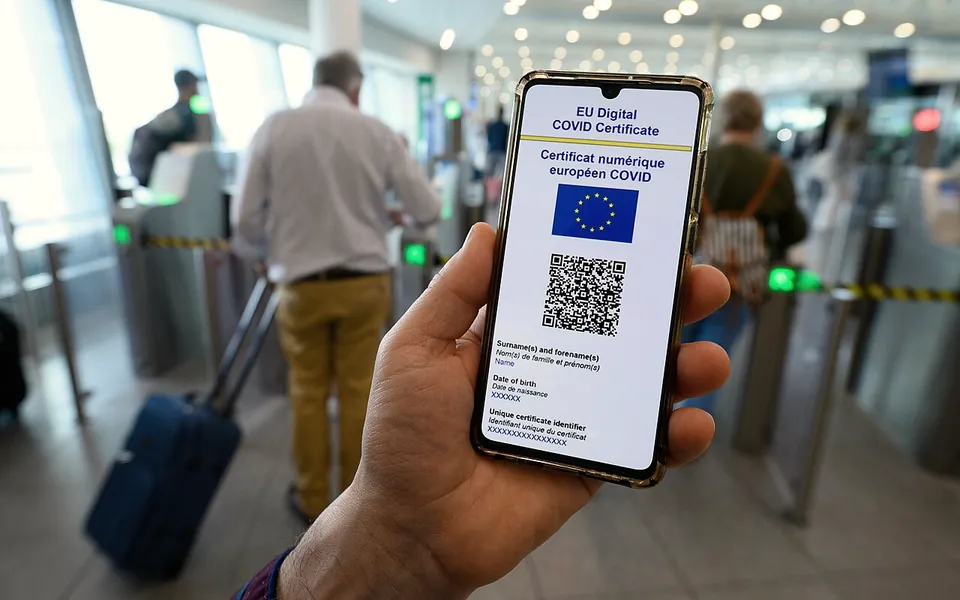
On 1 July 2021 the EU Digital COVID Certificate begins to apply throughout the European Union, created by Regulation (EU) 2021/953 of 14 June to facilitate free movement during the pandemic. The European Parliament and the Council had reached agreement on 20 May, and the gateway connecting national systems has been running since 1 June. For six weeks, until 12 August, member states that are not yet ready may issue other formats, which other countries should accept.
What it shows
The framework allows three types of certificate, each issued separately: a vaccination certificate, issued after each dose and stating whether the course is complete; a test certificate, for PCR (NAAT) tests or rapid antigen tests on the common EU list carried out by health professionals, stating the type of test, the date and the result; and a recovery certificate, for those who have had the disease following a positive PCR test, which may be issued no earlier than eleven days after that test.
It is issued free of charge, on paper or in digital form at the holder’s choice, with an interoperable QR code that allows its authenticity to be verified and with the data also in human-readable form, at least in the language of the issuing country and in English. Each certificate carries a warning that it is not a travel document. When it is checked in another country, the electronic signature is verified without notifying the issuer, and the data are not stored.
How to get it in Spain and Catalonia
Spain began issuing it on 7 June, about twenty days before it became compulsory. The Ministry of Health’s online office lets people who were vaccinated in Spain or have had the disease obtain vaccination and recovery certificates with a digital certificate or permanent Cl@ve. In general the autonomous communities issue them, and the test certificate is handled only that way; the Ministry expected all of them to be able to issue all three, online and in person, before 1 July. It is free, both online and in person.
In Catalonia, the Department of Health opened the service on 8 June through the La Meva Salut website: under the “informes i resultats” tab there is a “Certificat COVID Digital UE” section, from which the vaccination or recovery certificate can be requested, the latter from eleven days after a positive test. The document is generated as a PDF with a QR code, in Catalan, Spanish and English. When the service was announced, the negative test certificate was not yet available.
Travel and tourism
The regulation provides that holding the certificate is not a precondition for exercising free movement and that there may be no discrimination based on holding one type of certificate or another. Countries that accept vaccination, negative test or recovery certificates must refrain from imposing additional restrictions, such as further tests or quarantine, unless they are necessary and proportionate to protect public health. If a state imposes new conditions on holders, it must inform the Commission and the other states, if possible 48 hours beforehand.
In Spain, since 7 June, travellers who are fully vaccinated with a vaccine authorised by the EMA or the WHO may enter, whatever their origin, once 14 days have passed. Those arriving from Schengen countries may show vaccination, a negative test (for the first time including antigen tests) or recovery from the disease in the last six months, and EU travellers may use the certificate issued by any European country. The SpTH system and the health control form remain compulsory. According to the government, it is possible to travel without a certificate by meeting the health requirements, but entry will be slower and additional measures may be required.
Before travelling it is worth having the certificate already downloaded, on a phone and on paper, and checking what each destination requires, because the rules keep changing; outside the EU, each country decides what it accepts. Ask your travel agent or the authorities of the destination country.
The certificate does not open borders by itself, but it spares travellers a different piece of paper for every country.
This article is general information. It is not legal, tax or investment advice, and it does not take anyone’s particular circumstances into account.