On 13 October 2025 the Swedish Academy awarded the prize to Joel Mokyr, Philippe Aghion and Peter Howitt for explaining how innovation sustains economic growth.
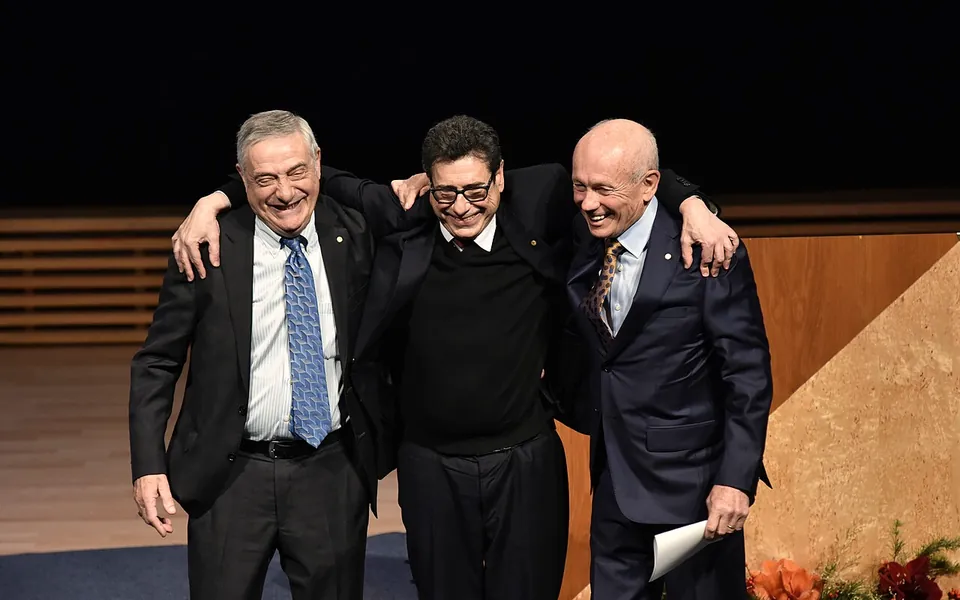
On 13 October 2025 the Royal Swedish Academy of Sciences awarded the Sveriges Riksbank Prize in Economic Sciences in Memory of Alfred Nobel to three economists who have studied innovation-driven growth. Half the prize went to Joel Mokyr of Northwestern University “for having identified the prerequisites for sustained growth through technological progress”, and the other half, shared equally, to Philippe Aghion of the Collège de France, INSEAD and the London School of Economics and Peter Howitt of Brown University “for the theory of sustained growth through creative destruction”.
What they explain
For almost all of history, living standards barely changed from one generation to the next. Since the Industrial Revolution, by contrast, part of the world has enjoyed two centuries of continuous growth. Mokyr, drawing on economic history, argues that the key was the combination of scientific knowledge and practical know-how, in societies open to new ideas and willing to accept change.
In 1992 Aghion and Howitt formalised a model of “creative destruction”, Joseph Schumpeter’s idea that innovating firms displace those that fall behind. In their model, growth comes from successive innovations that build on one another, and the prospect of profiting from them drives investment in research. But the process has losers: firms that close and jobs that disappear.
Why it matters to a business
The prize comes as artificial intelligence promises a leap in productivity while also raising fears of job losses, and as Europe debates how to close its innovation gap with the United States, as the 2024 Draghi report set out. The laureates warn that growth cannot be taken for granted: it can stall if incumbent firms block competition or if society resists change.
For a business, the lesson is familiar but useful: today’s advantage erodes without investment in innovation, and competition, often seen as a threat, is also what forces improvement. For governments, the challenge is to protect workers hit by change without protecting firms that stop innovating.
Worth remembering
The economics prize is not one of the five original Nobel prizes: Sweden’s central bank created it in 1968 and it has been awarded alongside the others since 1969. In 2025 it carried 11 million Swedish kronor.
Lasting growth is a relay race between the new and what has stopped being useful.
This article is general information. It is not legal, tax or investment advice, and it does not take anyone’s particular circumstances into account.