On 6 May 2023 Charles III and Camilla were crowned at Westminster Abbey, the first British coronation in seventy years. What happened and what the ceremony means.
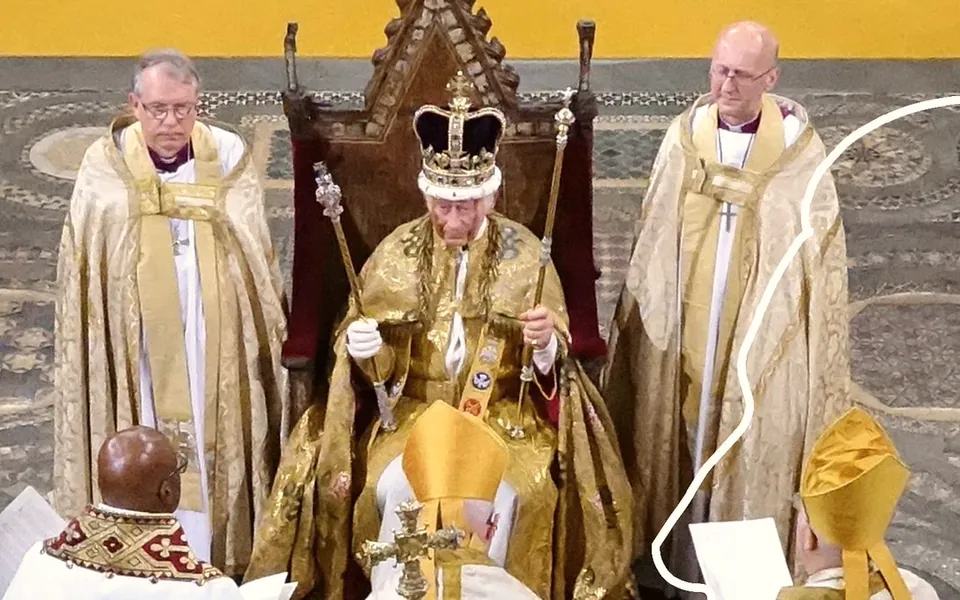
On Saturday 6 May 2023, Charles III and his wife, Camilla, were crowned at Westminster Abbey in London, in a religious service led by the Archbishop of Canterbury, Justin Welby. It was the first British coronation since that of Elizabeth II on 2 June 1953. To mark the occasion, Monday 8 May was a bank holiday in England and Wales.
What happened
The day began with a procession from Buckingham Palace to the Abbey, with about 1,000 military personnel lining the route and a large police presence in central London. Inside the Abbey there were more than 2,000 guests, among them dozens of foreign dignitaries. King Felipe VI and Queen Letizia of Spain watched the ceremony and then attended a reception at Church House, according to the Spanish Embassy in London.
The service followed the traditional order. The king swore oaths and was anointed with consecrated oil, a moment kept from the cameras behind a screen. Welby then crowned him with St Edward’s Crown, made in the seventeenth century for Charles II. The king, who is 74, then received the homage of his son William, the Prince of Wales, and of the senior clergy of the Church of England. Camilla was crowned shortly afterwards with an adapted version of Queen Mary’s Crown, dating from 1911.
Prime Minister Rishi Sunak read a passage from the Bible during the service. Outside, police arrested several anti-monarchy protesters, among them the head of the group Republic, near Trafalgar Square; the organisation said its protest was peaceful. At the end, the king and queen returned to the palace in a second procession and appeared on the balcony as military aircraft flew over the area.
What it means
It is worth separating the coronation from the succession. Charles III has been king since 8 September 2022, the day Elizabeth II died: in the United Kingdom the new sovereign takes the throne immediately, without waiting for any ceremony. The coronation is a religious and symbolic service that consecrates the title before the country and the Church; it does not confer it.
The king is head of state of the United Kingdom and of 14 other countries, known as the Commonwealth realms. He is also head of the Commonwealth itself, a voluntary association of 56 independent countries, most of which do not have him as head of state. His role is constitutional and representative: policy is decided by the government that emerges from elections. In his message on coronation day, the king said he was rededicating his life to serving the people of the United Kingdom, the realms and the Commonwealth.
Why it matters beyond the UK
The coronation brings no measures that affect businesses or personal wealth: it is an institutional occasion, not a political or economic decision. Nothing that happened on 6 May changes the rules on trade, investment or residence between the United Kingdom and Spain, which since Britain left the European Union in 2020 depend on the post-Brexit framework.
For readers in Barcelona the interest is mainly institutional and topical. The ceremony shows how a parliamentary monarchy keeps centuries-old rituals within a modern constitutional structure, and the presence of the Spanish monarchs reflects the relationship between the two royal houses and between the two countries. Above all it was a day of tradition and protocol; the legal and economic framework remains where it was.
This article is general information. It is not legal, tax or investment advice, and it does not take anyone’s particular circumstances into account.